Tuesday, December 16, 2025

Monday, November 24, 2025
Monday, October 20, 2025
Monday, October 6, 2025
Thursday, September 18, 2025
Saturday, September 6, 2025
Tuesday, August 26, 2025
Monday, August 18, 2025
Monday, June 23, 2025
Shhh... Meet the Quietest Chicken breeds
Hey there, future flock-keepers! If you’ve been day-dreaming about gathering breakfast in your pajamas without a 5 a.m. rooster-alarm, you’re in the right place. Today we’re talking about chickens that keep the decibels (and the neighbor complaints) to a minimum.
Wait — are any chickens truly “silent”?
Not exactly. All hens announce a fresh egg with a short “egg song,” and every bird mutters to her flockmates. But some breeds have naturally softer voices and calmer personalities, which keeps overall noise low.
Quick-look Cheat Sheet
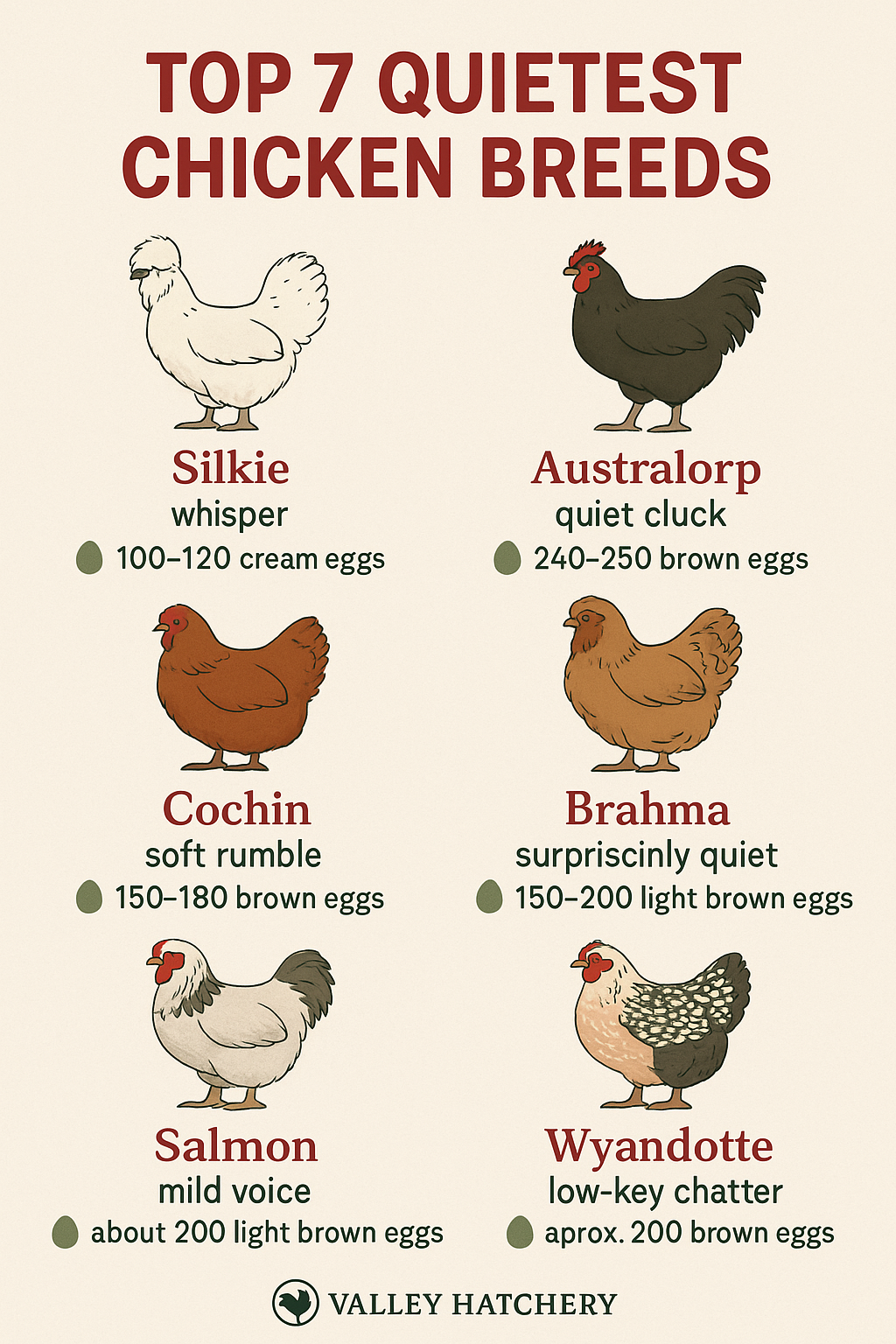
1. Silkie
Noise vibe: whisper-soft peeps
Eggs: 100-120 tiny cream gems/year
Fluffy, pint-sized, and practically a therapy chicken. Great for kids and small backyards, but don’t expect a flood of eggs.
2. Australorp
Noise vibe: gentle “quiet-cluck”
Eggs: 240-250 large browns/year
Australia’s record-setting layer delivers plenty of breakfast with very little drama.
3. Buff Orpington
Noise vibe: low chatter
Eggs: 180-200 browns/year
Often called the “golden retriever” of chickens—docile, friendly, and great with kids. Give them shade; that thick buff coat gets toasty.
4. Cochin
Noise vibe: soft rumble
Eggs: 150-180 browns/year
These feather-footed fluffballs waddle instead of sprint and prefer a calm coop. Heavy bodies mean sturdier roosts are a must.
5. Brahma
Noise vibe: surprisingly quiet giants
Eggs: 150-200 lights/year, even in winter
Their sheer size looks intimidating, but their voices are barely above a hum.
6. Salmon Faverolle
Noise vibe: mild, sweet voice
Eggs: about 200 light-tinted/year
Bearded, five-toed charmers that get along with everyone—just keep them busy so they don’t wander.
7. Wyandotte
Noise vibe: steady, low-key chatter
Eggs: ~200 browns/year
Hardy in cold climates thanks to their rose combs, and their laced feathers are pure eye-candy.
Perks and Tradeoffs of a Quieter Coop 


- Rooster optional. You don’t need a rooster for eggs, and he’s the loudest bird in the yard.
- Space matters. Crowded hens complain; shoot for 4 sq ft inside/10 sq ft outside per bird.
- Routine feeding. Empty feeders equal squawking. Set reminders or use an automatic feeder.
- Black-out curtains. Blocking dawn light means hens wake up with you, not before you.
- Boredom busters. Hanging cabbages, dust baths, and forage boxes keep clucks conversational, not cranky.
Here’s to fresh eggs without the ruckus! 

Wednesday, February 21, 2024
Top 5 Chicken-Friendly Plants for Your Backyard Coop
If you're looking to diversify your flock's diet and spruce up their environment, growing some chicken-friendly plants is a fantastic idea. Not only do these plants provide your chickens with additional nutrients and entertainment, but they also beautify your space. Here's a roundup of the top five plants that are both beneficial for your chickens and easy to grow.
 1. Sunflowers 🌻

Sunflowers aren't just beautiful; they're a powerhouse of nutrition. Once they mature, you can harvest the seeds as a protein-rich snack for your chickens. Plus, during their growing season, they offer shade and shelter for your flock. Sunflowers are easy to grow and thrive in most soil types, making them a sunny addition to any chicken-friendly garden.
2. Marigolds 🌼
Bright and cheerful, marigolds are a fantastic addition to your chicken coop's surroundings. They're known for their pest-repellent properties, keeping unwanted bugs away from your chickens and garden. Marigolds are also edible and can contribute to a more vibrant egg yolk when consumed by your flock. Easy to grow and maintain, they're a must-have for a happy, healthy coop.
3. Mint 🍃
Mint is a versatile and hardy herb that's great for chickens. It's known for its strong aroma, which can help repel pests and rodents from the coop. Plus, mint has cooling properties that can be beneficial during the warmer months. Just be mindful of its invasive nature; growing mint in containers can help keep it under control.
4. Kale 🥬
Kale is a nutritional powerhouse for both humans and chickens. It's rich in vitamins and minerals, making it a great snack for your feathered friends. Kale is cold-hardy, making it an excellent option for year-round cultivation. It's relatively easy to grow, and since chickens love to peck at its leaves, it can provide endless entertainment for them.
5. Lavender 💜
Lavender isn't just for making your garden look and smell amazing; it's also great for chickens. The soothing scent of lavender can help reduce stress in your flock and repel insects. Plus, it can be used in nesting boxes to promote a calm environment. Lavender requires well-drained soil and full sun but is generally low-maintenance once established.
Incorporating these plants into your backyard not only makes for a happier and healthier flock but also turns your space into a vibrant and aromatic haven. Remember to introduce any new foods to your chickens gradually and ensure they always have access to fresh water. Happy gardening and chicken raising! 🌸🐥
Friday, December 29, 2023
Protecting Your Urban Chickens - Part 2
Part 2 in our series about protection of your urban flock begins with the premise that you already have a secure coop. This article is mostly about other steps you can take to provide further protection using additional items or technologies in conjunction with a safe, sturdy coop. You can read Part 1 here, if you missed it.
Using plants and landscaping to deter predators
Creating a predator-proof fortress for your urban chickens doesn't mean sacrificing aesthetics. You can use plants and landscaping to your advantage. Strategic placement of thorny bushes, such as roses or blackberries, can deter predators from getting too close to the coop. Additionally, tall grasses or dense shrubs near the perimeter of your coop can provide cover for your chickens. Be careful though, as tall grasses and brush at the outer reaches of your yard can provide cover for predators and make it easier for predators to approach unseen.
Implementing effective lighting and sound deterrents
Predators can be discouraged by well-placed lighting and sound. Install motion-activated lights around the coop and run to startle potential threats. You can also set up a radio with a timer to play during the night, as human voices or loud music can deter nocturnal predators.
Protecting chickens during free-roaming hours
While allowing your chickens to roam freely in your yard is a perk of urban chicken-keeping, it also exposes them to more risks. Limiting free-roaming hours to daylight when predators are less active can minimize the danger. Always ensure your chickens have a secure coop to retreat to and consider using portable fencing to create a safe roaming area. Make sure your birds all come in by dusk.
Utilizing advanced technology for protection
Exploring automated coop doors and predator alarms
For a hands-off approach, invest in automated coop doors that open and close at specified times. This ensures your chickens are safely locked up at night without requiring your constant attention. Predator alarms can also be installed, emitting high-pitched sounds or flashing lights to scare off intruders.
Using surveillance cameras and motion sensors
Modern technology can be a great ally in protecting your urban chickens. Set up trail cams to monitor the yard, the coop and run, allowing you to keep an eye on potential threats remotely. Motion sensors can trigger alerts, notifying you of any suspicious activity in real-time. Even if you don't opt for real-time notification, camera files can be reviewed regularly for anything unusual that might be happening while you aren't out there.

Monitoring systems and smartphone applications for remote monitoring
Take advantage of monitoring systems and smartphone apps designed for chicken keepers. These tools allow you to check on your flock remotely, monitor temperature and humidity levels, and receive notifications if any issues arise. It's like having a virtual chicken sitter in your pocket! You can even recycle your old phones to use as wireless cameras by using freely available "webcam" software and your home's wi-fi capabilities.
Thursday, December 14, 2023
Urban Chickens - Are They For You?
There is definitely a mounting trend in America regarding the little bird scientifically known as Gallus Gallus Domesticus. The Chicken. Or more specifically, the domesticated and now, urbanized chicken. The backyard chicken. The Neighbor's chicken. Maybe even your chicken!
What Are Urban Chickens?
If you are unfamiliar with the term "urban, chickens," the University of Kentucky defines it like this:
The terms urban poultry and backyard poultry both refer to flocks kept on residential lots. Keeping chickens in urban areas is becoming increasingly popular throughout the country. The main reasons for keeping chickens are as pets and for egg production—pets with benefits.
http://www2.ca.uky.edu/agc/pubs/ASC/ASC241/ASC241.pdf
Probably the main idea to take note of in here is that these birds are usually pets who live on your residential lot with you. Just like taking on a cat or a dog, the owner is assuming a significant responsibility for feeding, housing, and caring for their chickens, as well as keeping those pets within their property lines, and abiding by any neighborhood, or civic restrictions that might affect how they keep their chickens. While rural chicken owners might also have some of these considerations, the urban chicken owner usually has closer neighbors and more strict rules to follow.
On the plus side, it can also be easier for the urban chicken owner to find someone to look in on their chickens for them if they need to go out of town.
Before You Buy
If you are planning to join the ranks of urban chicken farmers, here are some things you may want to to consider in advance of that first little cheep arriving at your home:
- Check neighborhood, town, city, or county restrictions on backyard chicken raising. You might find out that there are limits not only on the number and gender of chickens you are allowed to have, but minimum/maximum requirements on the size of the coop and run, minimum distance from other homes.
- Review noise ordinances just to be on the safe side. A lot of folks believe that "no roosters" means you will have a quiet hen yard. Nope. Hens singing the "egg song" can be quite noisy.
- Read about a wide variety of breeds before you make your choice of which chickens to raise. This can be pretty intimidating at first, so it can be useful to break things down into categories and read about those first, like chickens who do best in cold climates, or learning about terminology, like learning what "straight run" means.
- Make a realistic price list for the basic accessories you're going to have to buy if you choose to raise chickens - a coop, a covered run, feed, as well as something to put that feed and water in if you don't want to waste it. If you're likely to experience extreme heat or cold situations, also price in appropriate accessories for dealing with those extremes so you aren't blindsided when the extreme weather hits.
- Ask if your local vet will see chickens. Chickens can get sick or be injured - it can be helpful to decide in advance whether or not vet visits for your chickens are even possible in your area. Some folks spend money for vet visits, some don't - you need to think about which option is right for you (or even available) before you are forced to choose.
- Factor in time - whether it's cleaning a coop, gathering eggs, or just checking on the flock, you will need to come to grips with the demands your backyard flock will make on your spare time. Some folks have coffee with their chickens every morning, some just see them at feeding time. You'll figure out which you are eventually but it's still worth thinking about your existing free time and considering how many of them you are ready to devote to poop-scooping! (see the first point about local restrictions - you might be required to clean your coop more often than you plan to.)


-
 Hey there, future flock-keepers! If you’ve been day-dreaming about gathering breakfast in your pajamas without a 5 a.m. rooster-alarm, you...
 -
 When diving into the world of ordering day-old chicks online, it's the beginning of a virtual journey to building your feathered flock. ...
 -
Join us as we explain why "vegetarian chickens" are a modern myth. Those backyard chickens of yours will eat everything. That...
